
Chapter 13: Field Theory
13.1 Basic Theory of Field Extensions
Definition: The characteristic of a field , denoted , is the smallest such that if such a exists. Otherwise, .
Proposition 1: is either or a prime . If then for any , .
Fact: This notion of a characteristic makes sense for an integral domain too, whose characteristic will be the same as for its fields of fractions.
Definition: The prime subfield of a field is the subfield of generated by the multiplicative identity of . It is isomorphic to if or if .
Definition: If is a field containing the subfield , then is said to be an extension field or simply an extension of , denoted or by the diagram
In particular, every field is an extension of its prime subfield. The field is sometimes called the base field of the extension.
Fact: If is any extension of fields, then the multiplication defined in makes a vector space over . In particular every field can be considered a vector space over its prime field.
Definition: The degree (or relative degree or index) of a field extension , , is the dimension of as a vector space over (i.e., ). The extension is said to be finite if is finite and is otherwise infinite.
Proposition 2: Let be a field homomorphism. Then is either identically or is injective, i.e. or .
Theorem 3: Let be a field and let be an irreducible polynomial. Then there exists a field containing an isomorphic copy of in which has a root. Identifying with this isomorphic copy shows that there exists an extension of in which has a root.
Theorem 4: Let be an irreducible polynomial of degree over the field and let be the field . Let . Then the elements are a basis for as a vector space over , so . Hence , i.e. all polynomials of degree in .
Corollary 5: Let be as in Theorem 4 and let be two polynomials of degree in . Then addition in is analogous to usual polynomial addition and multiplication in is defined by , where .
Definition: Let be an extension of the field and let . Then the smallest subfield of containing both and the elements is called the field generated by over F and denoted .
Definition: If the field is generated by a single element over , , then is said to be a simple extension of and the element is called a primitive element for the extension.
Fact: Every finite extension of a field of characteristic is a simple extension.
Theorem 6: Let be a field and let be irreducible. Suppose extends and contains a root of . Then . In particular, any field over in which contains a root must contain a subfield isomorphic to the extension of constructed in Theorem 3 and that this field is, up to isomorphism, the smallest extension of containing such a root.
Corollary 7: Suppose in Theorem 6 that . Then .
Fact: The roots of an irreducible polynomial are algebraically indistinguishable in the sense that the fields obtained by adjoining any root of an irreducible polynomial are isomorphic.
Theorem 8: Let be a field isomorphism. Let be be irreducible and let be the polynomial obtained by applying to the coefficients of . Let be a root of in some extension of and let be a root of in some extension of . Then there exists an isomorphism such that and such that extends , i.e. restricted to is the isomorphism . Pictorially, it is
13.2 Algebraic Extensions
Let be a field and be an extension of .
Definition: The element is algebraic over if for some nonzero . If is not algebraic over , then is transcendental over . is algebraic if every element of is algebraic over .
Fact: If is algebraic over then it is trivially algebraic over any extension field of .
Proposition 9: Let be algebraic over . Then there exists a unique monic irreducible polynomial for which is a root. has in .
Corollary 10: If is an extension of fields and is algebraic over both and , then in .
Definition: The polynomial is called the minimal polynomial for over . The degree of is also called the degree of .
Proposition 11: Let be algebraic over . Then , and thus , i.e. the degree of over is the degree of the extension it generates over .
Proposition 12: The element is algebraic over the simple extension is finite. More precisely, if is an element of an extension of degree over then is a root of a polynomial of degree at most over , and if satisfies a polynomial of degree over then the degree of over is at most .
Corollary 13: If the extension is finite, then it is algebraic.
Fact: Any extension of such that is of the form , where such that is not a square in , and conversely every extension of the form has degree . These are known as the quadratic extensions of .
Theorem 14: Let be fields. Then , i.e. extension degrees are multiplicative, and if one side of the equation is infinite, the other side is also infinite. Pictorially,
Corollary 15: Suppose is a finite extension and let . Then .
Definition: An extension is finitely generated if such that .
Lemma 16: , i.e. the field generated over by and is the field generated by over the field generated by .
Fact: The field for algebraic is typically obtained by adjoining to and then closing the resulting set with respect to addition and multiplication. The process terminates when a power of is a linear combination of lower powers of , i.e. finding the minimal polynomial for . If is non-algebraic, it is necessary to also close with respect to additive and multiplicative inverse.
Theorem 17: The extension is finite is finitely finitely generated by algebraic elements over of . More precisely, let be algebraic with degrees . Then .
Corollary 18: Suppose are algebraic over . Then are all algebraic.
Corollary 19: Let be an arbitrary extension. Then the set of elements of that are algebraic over form a subfield of .
Theorem 20: If is algebraic over and is algebraic over , then is algebraic over .
Definition: Let . Then the composite field of and , denoted , is the smallest subfield of with . This extends to any number of subfields.
Proposition 21: Let be two finite extensions of a field . Then . Equality is true an -basis for one of the fields remains linearly independent over the other field. If and are the bases for and , respectively, then the elements span over . Pictorially, 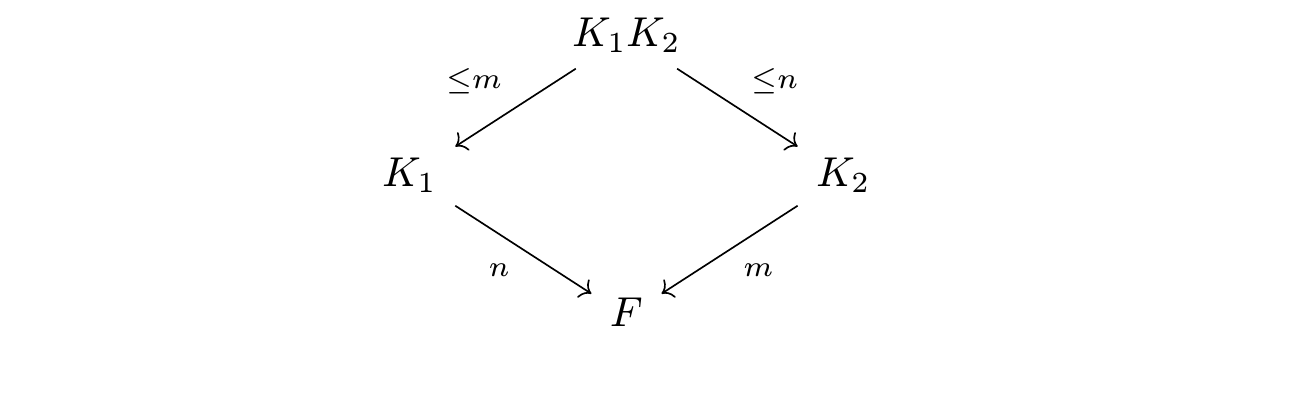 Corollary 22: Suppose that , in Proposition 21, where . Then .
13.3 Classical Straightedge and Compass Constructions
Proposition 23: If the element is obtained from a field by a series of compass and straightedge constructions then for some integer .
Theorem 24: None of the classical Greek problems: (I) Doubling the Cube, (II) Trisecting and Angle, and (III) Squaring the Circle, is possible.
13.4 Splitting Fields and Algebraic Closures
Let be a field.
Definition: The extension field of is called a splitting field for the polynomial if factors (splits) completely into linear factors in and does not factor completely over any proper subfield of containing .
Theorem 25: If then there exists an extension of which is a splitting field for .
Fact: If such that , then the splitting field of for is simply . If and is irreducible, then the algebraic extension over for some root of contains all roots of . If , then the splitting field may be a chain of algebraic extensions.
Definition: If is an algebraic extension of which is the splitting field over for a collection of polynomials then is called a normal extension of .
Proposition 26: A splitting field of a polynomial of degree over is of degree at most over .
Definition: A generator of the cyclic group of all th roots of unity is called a primitive th root of unity .
Definition: The field is called the cyclotomic field of th roots of unity.
Fact: The polynomial is the minimal polynomial for and has degree . In general, .
Theorem 27: Let be a field isomorphism. Let be a polynomial and let be the polynomial obtained by applying to the coefficients of . Let be a splitting field for over and let be a splitting field for over . Then the isomorphism extends to an isomorphism , i.e. restricted to is . Pictorially,  Corollary 28: (Uniqueness of Splitting Fields) Any two splitting fields for a polynomial over a field are isomorphic.
Definition: The field is called an algebraic closure of is is algebraic over and if every polynomial splits completely over (that is, contains all the elements algebraic over ).
Definition: A field is algebraically closed if every polynomial with coefficients in has a root in .
Proposition 29: Let be an algebraic closure of . Then is algebraically closed.
Proposition 30: For any field there exists an algebraically closed field containing .
Proposition 31: Let be an algebraically closed field and let be a subfield of . Then the collection of elements of that are algebraic over is an algebraic closure of . An algebraic closure of is unique up to isomorphism.
Theorem: (Fundamental Theorem of Algebra) The field is algebraically closed.
Corollary 32: The field contains an algebraic closure for any of its subfields. In particular, , the collection of complex numbers algebraic over , is an algebraic closure of .