Logo

Chapter 10: Parametric Equations and Polar Coordinates

10.1: Curves Defined by Parametric Equations

Parametrization of a curve means defining xx and yy in terms of a third variable tt called a parameter. This creates parametric equations:

x=f(t)y=g(t)x = f(t) \qquad \qquad y = g(t)

Each value of tt determines a point (x,y)(x, y). As tt varies over its domain, (x,y)(x, y) traces a curve CC called a parametric curve. (Note that tt does not necessarily represent time, and we could use other variable names instead of tt).

info

It is entirely possible for two distinct sets of parametric equations to generate the same set of points. It is also possible for two distinct values of tt to generate the same (x,y)(x, y).

For instance, x=cost,y=sintx = \cos t, y = \sin t and x=sint,y=costx = \sin t, y = \cos t generate the same set of points (a circle). However, the first set of parametric equations traces the curve in the counterclockwise direction, while the second set traces the curve in the clockwise direction.

example

Describe the parametric curve parametrized by the following: (h,k,rh,k,r are constants)

x=h+rcosty=k+rsintx = h + r \cos t \qquad y = k + r \sin t

We can attempt to eliminate the parameter tt to find an equation in terms of x,yx,y.

rcost=xhrsint=ykr2cos2t+r2sin2t=(xh)2+(yk)2r2=(xh)2+(yk)2\begin{gather*} r \cos t = x - h \qquad r \sin t = y - k \\ r^{2} \cos^{2} t + r^{2} \sin ^{2} t = (x - h)^2 + (y - k)^2 \\ r^{2} = (x - h)^2 + (y - k)^2 \\ \end{gather*}

Thus, this set of parametric equations describes a circle centered at (h,k)(h, k) with radius rr.

With parameterization, we can also restrict tt to a certain interval, i.e. atba \leq t \leq b. For a curve parametrized by the following conditions,

x=f(t)y=g(t)atbx = f(t) \qquad \qquad y = g(t) \qquad \qquad a \leq t \leq b

it has initial point (f(a),g(a))(f(a), g(a)) and terminal point (f(b),g(b))(f(b), g(b)).

Exercise:
Eliminate the parameter tt for the equations x=t2+ty=t2t\qquad x = t^{2} + t \qquad y = t^{2} - t
xy=2tx+y=2t2(xy)2=4t2=2(x+y)x2+y2+2xy2x2y=0\begin{gather*} x - y = 2t \qquad x + y = 2t^{2} \\ (x - y)^{2} = 4t^{2} = 2(x + y) \\ x^{2} + y^{2} + 2xy - 2x - 2y = 0 \\ \end{gather*}

This becomes a parabola aligned along x=yx = y.

Example: Cycloid

The cycloid is a curve traced by a point PP on the circumference of a circle that rolls along a straight line. (Page 683, Figure 13).

We will skip the derviation of the parametrization of the cycloid. (See Page 684 if interested). It is described by: (rr is constant)

x=r(θsinθ)y=r(1cosθ)θRx = r(\theta - \sin \theta) \qquad y = r(1 - \cos \theta) \qquad \theta \in \mathbb{R}

Let's now eliminate the parameter θ\theta

rθx=rsinθry=rcosθr2sin2θ+r2cos2θ=(rθx)2+(ry)2r2=(rθx)2+(ry)2r2(ry)2=rθxθ=r2(ry)2+xr\begin{gather*} r \theta - x = r \sin \theta \qquad r - y = r \cos \theta \\ r^{2} \sin ^{2} \theta + r^{2} \cos ^{2}\theta = (r \theta - x)^{2} + (r - y)^{2} \\ r^{2} = (r \theta - x)^{2} + (r - y)^{2} \\ \sqrt{ r^{2} - (r - y)^{2} } = r\theta - x \\ \theta = \dfrac{\sqrt{ r^{2} - (r - y)^{2} } + x}{r} \\ \end{gather*}

Having solved for θ\theta in terms of x,y,rx,y,r, we can effectively substitute for θ\theta in the original parametric equations to eliminate the parameter. (Although, it is a very, very ugly equation).

10.2 Calculus with Parametric Curves

info

In this section, "Cartesian Curve" will refer to a curve CC represented by equations with variables x,yx,y, and "Parametric Curve" will refer to a curve CC represented by equations x(t),y(t)x(t),y(t).

Derivative

Deriving dydx\frac{dy}{dx}

dydt=dydxdxdtIf dxdt0:dydx=dydtdxdt.\begin{gather*} \frac{dy}{dt} = \frac{d y }{d x } \cdot \frac{d x }{d t } \\ \text{If } \frac{d x }{d t } \neq 0: \frac{d y }{d x } = \dfrac{\frac{d y }{d t } }{\frac{d x }{d t } }. \end{gather*}

Deriving d2ydx2\frac{d^{2} y }{d x^{2} }

d2ydx2=ddx(dydx)=ddt(dydx)dxdt\begin{align*} \frac{d^{2} y }{d x^{2} } &= \frac{d}{dx} \left( \frac{d y }{d x } \right) && \\ &= \dfrac{\frac{d}{dt} \left( \frac{d y }{d x } \right)}{\frac{d x }{d t } } \end{align*}

The last step above is simply expanding ddx\frac{d}{dx} into ddtdxdt\dfrac{\frac{d}{dt}}{ \frac{d x }{d t }}.

Formulas

First and Second Derivative of a Parametric Curve
dydx=dydtdxdtd2ydx2=ddt(dydx)dxdt\begin{gather*} \frac{d y }{d x } = \dfrac{\frac{d y }{d t } }{\frac{d x }{d t } } \\ \frac{d^{2} y }{d x^{2} } = \dfrac{\frac{d}{dt} \left( \frac{d y }{d x } \right)}{ \frac{d x }{d t } } \end{gather*}

Horizontal and Vertical Tangents

The tangent line is...

Area

Suppose that some curve CC is traced by x=f(t)x = f(t) and y=f(t)y = f(t) as the parameter increases from αβ\alpha \to \beta. Then, if a=f(α)a = f(\alpha) and b=f(β)b = f(\beta):

A=abydx=αβydxdtdt\begin{align*} A &= \int_{a}^{b} y \, dx && \\ &= \int_{\alpha}^{\beta} y \, \frac{d x }{d t } dt \\ \end{align*}

Note that, if instead b=f(α)b = f(\alpha) and a=f(β)a = f(\beta), we can simply reverse the interval for the integral (the one in respect to tt).

Area under a Parametric Curve
A=αβydxdtdtA = \int_{\alpha}^{\beta} y \frac{d x }{d t } \, dt

Arc Length

Deriving for a Cartesian Curve

Let curve CC be described by y=F(x)y=F(x), where FF is differentiable. Additionally, let x=f(t)x = f(t) and y=g(t)y = g(t). Then the arc length LL of CC between axba\leq x\leq b can be obtained by partitioning [a,b][a,b] into nn subintervals of equal length, deriving an approximation for LL based on the partitions, and solving for limnL\lim_{ n \to \infty } L to derive the arc length formula.

First, the partitioning:

a=x0<x1<<xn1<xn=ba = x_{0} < x_{1} < \dots < x_{n-1} < x_{n} = b

The length of each subinterval is Δx=ban\Delta x = \frac{b - a}{n}.

For each subinterval xi1xix_{i - 1} \to x_{i}, we draw a line between the points (xi1,F(xi1))(x_{i - 1}, F(x_{i - 1})) and (xi,F(xi))(x_{i}, F(x_{i})). Let Δsi\Delta s_{i} be the length of this line.
Additionally, let Δxi=xixi1\Delta x_{i} = x_{i} - x_{i - 1} (yes, this is equivalent to Δx\Delta x) and let Δyi=yiyi1\Delta y_{i} = y_{i} - y_{i - 1}. Then:

Δsi=(Δxi)2+(Δyi2)\Delta s_{i} = \sqrt{ (\Delta x_{i})^{2} + (\Delta y_{i}^{2}) }

Now, the approximation of LL is simply:

Li=1nΔsiL \approx \sum_{i=1}^{n} \Delta s_{i}

Taking the limit:

L=limni=1nΔsiL = \lim_{ n \to \infty } \sum_{i=1}^{n} \Delta s_{i}

Remember that Δsi=ds\Delta s_{i} = ds. Rewritten, we can express this as

L=abdsL = \int_{a}^b ds

It suffices to then find an expression for dsds a.k.a. Δsi\Delta s_{i}.

Δsi=(Δxi)2+(Δyi)2=1+(ΔxiΔyi)2Δxi=1+(ΔxiΔyi)2Δx\begin{align*} \Delta s_{i} &= \sqrt{ (\Delta x_{i})^{2} + (\Delta y_{i})^{2} } && \\ &= \sqrt{ 1 + \left( \frac{\Delta x_{i}}{\Delta y_{i}} \right)^{2} } \Delta x_{i} \\ &= \sqrt{ 1 + \left( \frac{\Delta x_{i}}{\Delta y_{i}} \right)^{2} } \Delta x \\ \end{align*}

In other words,

ds=1+(ΔxiΔyi)2dxds = \sqrt{ 1 + \left( \frac{\Delta x_{i}}{\Delta y_{i}} \right)^{2} } dx

And thus,

L=ab1+(ΔxiΔyi)2dxL = \int_{a}^b \sqrt{ 1 + \left( \frac{\Delta x_{i}}{\Delta y_{i}} \right)^{2} } dx

And we're done!

Formal Interlude

By the Mean Value Theorem (MVT), since y=F(x)y = F(x) is differentiable, i{1,  ,  n}\forall i \in \{1,\; \dots, \; n\}, xi(xi1,xi)\exists x_{i}^* \in (x_{i-1}, x_{i}) such that

F(xi)=ΔyiΔxiF'(x_{i}^*) = \frac{\Delta y_{i}}{\Delta x_{i}}

i.e. there is some xix_{i}^* in the interval with the same slope as the slope of the line segment between the points (xi1,F(xi1))(x_{i - 1}, F(x_{i - 1})) and (xi,F(xi))(x_{i}, F(x_{i})).

Then,

L=limnΔsi=limn1+(ΔyiΔxi)2Δx=limn1+[F(xi)]2Δx=ab1+[F(xi)]2dx\begin{align*} L &= \lim_{ n \to \infty } \Delta s_{i} && \\ &= \lim_{ n \to \infty } \sqrt{ 1 + \left( \frac{\Delta y_{i}}{\Delta x_{i}} \right)^{2} } \Delta x \\ &= \lim_{ n \to \infty } \sqrt{ 1 + [F'(x_{i})]^{2} } \Delta x \\ &= \int_{a}^{b} \sqrt{ 1 + [F'(x_{i})]^{2} } \, dx \end{align*}

This is a slightly more formal last step to the proof, but it returns the same answer.

Arc Length for a Cartesian Curve
L=ab1+(dydx)2dxL = \int_{a}^{b} \sqrt{ 1 + \left( \frac{d y }{d x } \right)^{2} } \, dx

Deriving for a Parametric Curve

The derivation for the arc length formula for a parametric curve follows simply from the formula for a Cartesian curve.

L=ab1+(dydx)2dx=αβ1+(dydtdxdt)2dxdtdt=αβ(dxdt)2+(dydt)2dt\begin{align*} L &= \int_{a}^{b} \sqrt{ 1 + \left( \frac{d y }{d x } \right)^{2} } \, dx && \\ &= \int_{\alpha}^{\beta} \sqrt{ 1 + \left( \dfrac{\frac{d y }{d t } }{\frac{d x }{d t } } \right)^{2} }\, \frac{d x }{d t } dt \\ &= \int_{\alpha}^{\beta} \sqrt{ \left( \frac{d x }{d t } \right)^{2} + \left( \frac{d y }{d t } \right)^{2} } \, dt \end{align*}
Arc Length for a Parametric Curve
L=αβ(dxdt)2+(dydt)2dtL = \int_{\alpha}^{\beta} \sqrt{ \left( \frac{d x }{d t } \right)^{2} + \left( \frac{d y }{d t } \right)^{2} } \, dt

Surface Area

Deriving for a Cartesian Curve

We can revolve a curve CC around an axis to obtain a 3-dimensional shape CC'. For our purposes, we will consider rotating CC around the xx-axis on the interval axba \leq x \leq b for our derivation.

Just like in the 2-dimensional derivation for arc length, we will approximate CC by partitioning it into nn subintervals of equal length. Then, by rotating the line segments formed by the subintervals, we obtain an approximation for CC'.

cartesian-revolution-surface-area Figure 1. A diagram illustrating the method of approximating the shape of revolution of a Cartesian curve.

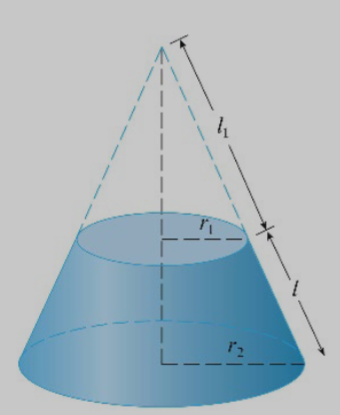
We can calculate the surface area of this shape by computing the lateral surface area of a frustum. *Note that the lateral surface area denotes the surface area of the frustum that does not include the circular bases.

Frustum?

A frustum is created when a cross section parallel to the cone's base (circle) splits the cone into two shapes: a cone above and a frustum below.
frustum.png

The lateral surface area of a frustum is

A=2πrlA = 2\pi rl

Where r=12(r1+r2)r=\frac{1}{2}(r_{1}+ r_{2}).
*The proof of this will be left out for brevity. Search it up if you're interested!

Thus, we can approximate the surface area of the shape of revolution by summing the surface areas of the frustums. Note that the symbols used here are equivalent to the symbols used [[#Arc Length#Deriving for a Cartesian Curve|here]].

Si=1nAi=i=1n2πyi1+yi2ΔsiS \approx \sum_{i=1}^n A_{i} = \sum_{i=1}^n 2\pi \frac{y_{i-1} + y_{i}}{2} \Delta s_{i}

Δsi\Delta s_{i} is the same as before. So we can write:

S=limni=1n2πyi1+yi21+(ΔxiΔyi)2Δx=ab2πy1+(dydx)2dx\begin{align*} S &= \lim_{ n \to \infty } \sum_{i=1}^{n} 2\pi \frac{y_{i - 1} + y_{i}}{2} \sqrt{ 1 + \left( \frac{\Delta x_{i}}{\Delta y_{i}} \right)^{2} } \Delta x && \\ &= \int_{a}^{b} 2\pi y \sqrt{ 1 + \left( \frac{\textrm{d} y }{\textrm{d} x } \right)^{2} } \, dx \end{align*}

** Note that yy is substituted for yi1+yi2\frac{y_{i - 1} + y_{i}}{2} for yy because yi1y_{i-1} and yiy_{i} become infinitely close to each other as nn tends to \infty. yy can be substituted with F(x)F(x) when actually solving.

Surface Area of a Cartesian Curve
S=ab2πy1+(dydx)2dxS = \int_{a}^{b} 2\pi y \sqrt{ 1 + \left( \frac{\textrm{d} y }{\textrm{d} x } \right)^{2} } \, dx

Deriving for a Parametric Curve

The process here is identical to the parametric derivation for arc length.

S=ab2πy1+(dydx)2dx=αβ2πy1+(dydx)2dxdtdt=αβ2πy(dxdt)2+(dydt)2dt\begin{align*} S &= \int_{a}^{b} 2\pi y \sqrt{ 1 + \left( \frac{\textrm{d} y }{\textrm{d} x } \right)^{2} } \, dx && \\ &= \int_{\alpha}^{\beta} 2\pi y\sqrt{ 1 + \left( \frac{\textrm{d} y }{\textrm{d} x } \right)^{2} } \, \frac{\textrm{d} x }{\textrm{d} t } dt \\ &= \int_{\alpha}^{\beta} 2\pi y\sqrt{ \left( \frac{\textrm{d} x }{\textrm{d} t } \right)^{2} + \left( \frac{\textrm{d} y }{\textrm{d} t } \right)^{2} } \, dt \end{align*}
Surface Area of a Parametric Curve
S=αβ2πy(dxdt)2+(dydt)2dtS = \int_{\alpha}^{\beta} 2\pi y\sqrt{ \left( \frac{\textrm{d} x }{\textrm{d} t } \right)^{2} + \left( \frac{\textrm{d} y }{\textrm{d} t } \right)^{2} } \, dt

Generalization

You may not necessarily rotate a curve around the xx-axis. Generally, you will be assigned to rotate around some line y=ky=k (vertical) or x=hx = h (horizontal). The formula is always similar, however. You simply replace yy with a formula for the radius rr.

Reference Formulas

Formulas
dydx=dydtdxdtd2ydx2=ddt(dydx)dxdtA=αβydxdtdtL=ab1+(dydx)2dxL=αβ(dxdt)2+(dydt)2dtS=ab2πy1+(dydx)2dxS=αβ2πy(dxdt)2+(dydt)2dt\begin{gather*} \frac{d y }{d x } = \dfrac{\frac{d y }{d t } }{\frac{d x }{d t } } \qquad\qquad \frac{d^{2} y }{d x^{2} } = \dfrac{\frac{d}{dt} \left( \frac{d y }{d x } \right)}{ \frac{d x }{d t } } \\ A = \int_{\alpha}^{\beta} y \frac{d x }{d t } \, dt \\ L = \int_{a}^{b} \sqrt{ 1 + \left( \frac{d y }{d x } \right)^{2} } \, dx \qquad L = \int_{\alpha}^{\beta} \sqrt{ \left( \frac{d x }{d t } \right)^{2} + \left( \frac{d y }{d t } \right)^{2} } \, dt \\ S = \int_{a}^{b} 2\pi y \sqrt{ 1 + \left( \frac{\textrm{d} y }{\textrm{d} x } \right)^{2} } \, dx \qquad S = \int_{\alpha}^{\beta} 2\pi y\sqrt{ \left( \frac{\textrm{d} x }{\textrm{d} t } \right)^{2} + \left( \frac{\textrm{d} y }{\textrm{d} t } \right)^{2} } \, dt \end{gather*}

10.3 Polar Coordinates

Intro

The polar coordinate system is an alternative to the Cartesian coordinate system, where a point PP is represented by (r,θ)(r, \theta). rr is the length of the line segment between the pole OO, which is typically the origin, and the point PP. (We choose the variable rr because it means radius). θ\theta is the angle between the line segment and the polar axis. The polar axis is a ray that is typically equivalent to the positive xx-axis.

polar-coords

Figure 2. A graph demonstrating polar coordinates. on the Cartesian plane.

Note that P(r,θ)=P(r,θ+πn)P(-r, \theta) = P(r, \theta + \pi n) for nZn \in \mathbb{Z} and nn odd. Also note that P(r,θ)=P(r,θ+2πn)P(r, \theta) = P(r, \theta + 2\pi n) for nZn \in \mathbb{Z}.

Polar curves are essentially just a special form of parametric curves. Many of the same ideas/formulas for parametric curves will apply here too!

Cartesian to Polar

We can write a couple equations that represent the relationship between polar and Cartesian coordinates.

Based on the definitions of cosθ\cos \theta and sinθ\sin\theta, we can write

cosθ=xrsinθ=yr\cos\theta = \frac{x}{r} \qquad\qquad \sin \theta = \frac{y}{r}

It may help to refer to Figure 2 to see why these equations are true.

From this, it's easy to derive the following:

Polar \to Cartesian Equations
x=rcosθy=rsinθx = r\cos\theta \qquad\qquad y = r\sin \theta

Subsequently, we may derive the following:

Cartesian \to Polar Equations
r2=x2+y2tanθ=yxr^{2} = x^{2} + y^{2} \qquad\qquad \tan\theta = \frac{y}{x}

Finally, note that the equation of a polar curve is typically denoted as r=f(θ)r = f(\theta).

Symmetry

When sketching polar curves, recognizing symmetry can help significantly.

Derivatives

To derive polar curves, we essentially consider them as parametric. (Because, that basically is what they are!)

As a reminder,

x=rcosθy=rsinθx = r\cos\theta \qquad\qquad y = r\sin\theta

Deriving,

dxdθ=drdθsinθ+rcosθdydθ=drdθcosθrsinθ\frac{\textrm{d} x }{\textrm{d} \theta } = \frac{\textrm{d} r }{\textrm{d} \theta } \sin\theta + r\cos\theta \qquad\qquad \frac{\textrm{d} y }{\textrm{d} \theta } = \frac{\textrm{d} r }{\textrm{d} \theta } \cos\theta - r\sin\theta

Therefore,

dydx=dydθdxdθ=drdθsinθ+rcosθdrdθcosθrsinθ\frac{\textrm{d} y }{\textrm{d} x } = \dfrac{\frac{\textrm{d} y }{\textrm{d} \theta } }{\frac{\textrm{d} x }{\textrm{d} \theta } } = \frac{\frac{\textrm{d} r }{\textrm{d} \theta } \sin\theta + r\cos\theta}{ \frac{\textrm{d} r }{\textrm{d} \theta } \cos \theta - r\sin\theta }
Derivative for a Polar Curve
dydx=drdθsinθ+rcosθdrdθcosθrsinθ\frac{\textrm{d} y }{\textrm{d} x } = \frac{\frac{\textrm{d} r }{\textrm{d} \theta } \sin\theta + r\cos\theta}{ \frac{\textrm{d} r }{\textrm{d} \theta } \cos \theta - r\sin\theta }

For some θ=k\theta=k:

Derivative at f(θ)=r=0f(\theta)=r=0

(Equivalent to a derivative at the pole)

dydx=tanθ if drdθ0\frac{\textrm{d} y }{\textrm{d} x } = \tan\theta \qquad \text{ if } \frac{\textrm{d} r }{\textrm{d} \theta } \neq 0

To find the 2nd derivative, we can follow the same steps as for a parametric curve. (Omitted for brevity).

10.4 Areas and Lengths in Polar Coordinates

Area

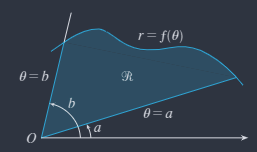
We define the area of a polar curve as the area swept out by the radius r=f(θ)r=f(\theta) between bounds aa and bb on θ\theta. For instance,
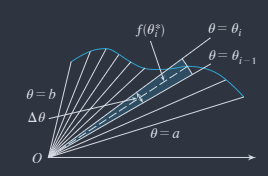
polar-area.png We can approximate this area by summing several sectors of circles:
polar-area-approx.png The area of a sector of a circle is

A=12r2θA = \frac{1}{2}r^{2}\theta

Therefore, we can approximate the area of the polar curve as

ΔAi=i=1n12[f(θi)]2Δθ\Delta A_{i} = \sum_{i=1}^{n} \frac{1}{2}[f(\theta_{i})]^{2} \Delta\theta

We take the limit as Δθ    n\Delta\theta\to \infty \implies n \to \infty:

limni=1n12[f(θi)]2Δθ=ab12[f(θ)]2dθ\lim_{ n \to \infty } \sum_{i=1}^{n} \frac{1}{2}[f(\theta_{i})]^{2} \Delta\theta = \int_{a}^{b} \frac{1}{2}[f(\theta)]^{2} \, d\theta

Therefore,

Area of a Polar Curve
A=ab12r2dθA = \int_{a}^{b} \frac{1}{2}r^{2} \, d\theta

Arc Length

For the arc length of a polar curve, it suffices to repurpose the equation for the arc length of a parametric curve. Remember:

L=ab(dxdθ)2+(dydθ)2dθL = \int_{a}^{b} \sqrt{ \left( \frac{\textrm{d} x }{\textrm{d} \theta } \right)^{2} + \left( \frac{\textrm{d} y }{\textrm{d} \theta } \right)^{2} } \, d\theta

By definition,

x=rcosθy=rsinθx=r\cos\theta \qquad\qquad y = r\sin\theta

Differentiating,

dxdθ=drdθcosθrsinθdydθ=drdθsinθ+rcosθ\frac{\textrm{d} x }{\textrm{d} \theta } = \frac{\textrm{d} r }{\textrm{d} \theta } \cos\theta - r\sin\theta \qquad\qquad \frac{\textrm{d} y }{\textrm{d} \theta } = \frac{\textrm{d} r }{\textrm{d} \theta } \sin\theta + r\cos\theta

So,

(dxdθ)2+(dydθ)2=(drdθ)2cos2θ2rdrdθcosθsinθ+r2+sin2θ+(drdθ)2sin2θ+2rdrdθsinθcosθ+r2cos2θ=(drdθ)2+r2\begin{align*} \left( \frac{\textrm{d} x }{\textrm{d} \theta } \right)^{2} + \left( \frac{\textrm{d} y }{\textrm{d} \theta } \right)^{2} &= \left( \frac{\textrm{d} r }{\textrm{d} \theta } \right)^{2}\cos ^{2}\theta - 2r \frac{\textrm{d} r }{\textrm{d} \theta } \cos\theta \sin\theta + r^{2}+\sin ^{2}\theta + \left( \frac{\textrm{d} r }{\textrm{d} \theta } \right)^{2}\sin ^{2}\theta + 2r \frac{\textrm{d} r }{\textrm{d} \theta } \sin\theta \cos\theta + r^{2}\cos ^{2}\theta \\ &= \left( \frac{\textrm{d} r }{\textrm{d} \theta } \right)^{2} + r^{2} \end{align*}

Thus,

Arc Length of a Polar Curve
L=abr2+(drdθ)2dθL = \int_{a}^{b} \sqrt{ r^{2} + \left( \frac{\textrm{d} r }{\textrm{d} \theta } \right)^{2} } \, d\theta