Logo

Lecture 10: Advanced Policy Gradients: Part 2

Mathematical Shortcuts So Far

When rewriting the importance sampling policy gradient formula with causality, we (1)(1) removed the BB term, i.e.

θJ(θ)=Eτpθ(τ)[t=1Hθlogπθ(atst)(t=1tπθ(atst)πθ(atst))A(t=tHr(st,at)(t=ttπθ(atst)πθ(atst))B)]\nabla_{\theta'}J(\theta') = \mathbb{E}_{\tau \sim p_{\theta}(\tau)} \left[ \sum_{t=1}^{H} \nabla_{\theta'}\log \pi_{\theta'} (\mathbf{a}_{t}\mid \mathbf{s}_{t}) \underbrace{ \left( \prod_{t'=1}^{t} \frac{\pi_{\theta'}(\mathbf{a}_{t'}\mid \mathbf{s}_{t'})}{\pi_{\theta}(\mathbf{a}_{t'}\mid \mathbf{s}_{t'})} \right) }_{ A } \left( \sum_{t'=t}^{H} r( \mathbf{s}_{t'},\mathbf{a}_{t'}) \underbrace{ \cancel{ \left( \prod_{t''=t}^{t'} \frac{\pi_{\theta'}(\mathbf{a}_{t''}\mid \mathbf{s}_{t''})}{\pi_{\theta}(\mathbf{a}_{t''}\mid \mathbf{s}_{t''})} \right) } }_{ B } \right) \right]

Which corresponds to essentially using the advantage with respect to the policy πθ\pi_{\theta}, A^πθ\hat{A}^{\pi_{\theta}}, instead of the advantage with respect to the policy we're improving, A^πθ\hat{A}^{\pi_{\theta'}}. That is, leaving in the BB term uses importance sampling to correct the advantage according to the importance sampling ratio between the two distributions; removing it means using the advantage without adjusting for the difference in distribution.

We also replaced term AA with a state-action marginal, which is equivalent under expectation,

θJ(θ)1Ni=1Nt=1Hπθ(st(i))πθ(st(i))πθ(at(i)st(i))πθ(at(i)st(i))θlogπθ(at(i)st(i))A^t(i)\nabla_{\theta'}J(\theta') \approx \frac{1}{N}\sum_{i=1}^{N} \sum_{t=1}^{H} \cancel{ \frac{\pi_{\theta'}(\mathbf{s}_{t}^{(i)})}{\pi_{\theta}(\mathbf{s}_{t}^{(i)})} } \cdot\frac{\pi_{\theta'}(\mathbf{a}_{t}^{(i)}\mid\mathbf{s}_{t}^{(i)})}{\pi_{\theta}(\mathbf{a}_{t}^{(i)}\mid\mathbf{s}_{t}^{(i)})}\nabla_{\theta'}\log \pi_{\theta'}(\mathbf{a}_{t}^{(i)}\mid \mathbf{s}_{t}^{(i)})\hat{A}_{t}^{(i)}

and (2)(2) ignored the mismatch between the state distributions of the two policies.

In short, there are two shortcuts:

  1. Incorrect advantage
  2. Incorrect state distribution

Policy Iteration \to Policy Gradient (Incorrect Advantage)

Policy gradient, notably, may be viewed as policy iteration.

  1. Estimate A^π(st,at)\hat{A}^{\pi}(\mathbf{s}_{t},\mathbf{a}_{t}) for current policy π\pi.
  2. Use A^π\hat{A}^{\pi} to produce an improve policy π\pi'.

We can formalize this by using an alternate objective

J(θ)J(θ)=Eτpθ(τ)[tγtAπθ(st,at)]\begin{align*} J(\theta')-J(\theta) &= \mathbb{E}_{\tau \sim p_{\theta'}(\tau)}\left[ \sum_{t}\gamma^{t}A^{\pi_{\theta}}(\mathbf{s}_{t},\mathbf{a}_{t}) \right] \end{align*}

where we define

J(θ)=Eτpθ(τ)[tγtr(st,at)]J(\theta) = \mathbb{E}_{\tau \sim p_{\theta}(\tau)}\left[ \sum_{t}\gamma^{t}r(\mathbf{s}_{t},\mathbf{a}_{t}) \right]

we will attempt to prove this claim of equality.

Why do this?

Note that calculating the advantage AπθA^{\pi_{\theta}} is easy—we use the estimator A^\hat{A} we've constructed—while calculating the advantage AπθA^{\pi_{\theta'}} is hard, since we lack an estimator for the new policy.

Proof.

J(θ)J(θ)=J(θ)Es0p(s0)[Vπθ(s0)](1)=J(θ)Eτpθ(τ)[Vπθ(s0)](2)=J(θ)Eτpθ(τ)[t=0γtVπθ(st)t=1γtVπθ(st)](3)=J(θ)+Eτpθ(τ)[t=0γt(γVπθ(st+1)Vπθ(st))](4)=Eτpθ(τ)[t=0γtr(st,at)]+Eτpθ(τ)[t=0γt(γVπθ(st+1)Vπθ(st))](5)=Eτpθ(τ)[t=0γt(r(st,at)+γVπθ(st+1)Vπθ(st))](6)=Eτpθ(τ)[t=0γtAπθ(st,at)](7)\begin{align*} J(\theta')-J(\theta) &= J(\theta')-\mathbb{E}_{\mathbf{s}_{0}\sim p(\mathbf{s}_{0})}[V^{\pi_{\theta}}(\mathbf{s}_{0})] && (1) \\ &= J(\theta') - \mathbb{E}_{\tau \sim p_{\theta'}(\tau)}[V^{\pi_{\theta}}(\mathbf{s}_{0})] && (2) \\ &= J(\theta')-\mathbb{E}_{\tau \sim p_{\theta'}(\tau)}\left[ \sum_{t=0}^{\infty} \gamma^{t}V^{\pi_{\theta}}(\mathbf{s}_{t}) - \sum_{t=1}^{\infty} \gamma^{t}V^{\pi_{\theta}}(\mathbf{s}_{t}) \right] && (3) \\ &= J(\theta')+\mathbb{E}_{\tau \sim p_{\theta'}(\tau)}\left[ \sum_{t=0}^{\infty} \gamma^{t}(\gamma V^{\pi_{\theta}}(\mathbf{s}_{t+1})-V^{\pi_{\theta}}(\mathbf{s}_{t})) \right] && (4) \\ &= \mathbb{E}_{\tau \sim p_{\theta'}(\tau)}\left[ \sum_{t=0}^{\infty} \gamma^{t}r(\mathbf{s}_{t},\mathbf{a}_{t}) \right] + \mathbb{E}_{\tau \sim p_{\theta'}(\tau)}\left[ \sum_{t=0}^{\infty} \gamma^{t}(\gamma V^{\pi_{\theta}}(\mathbf{s}_{t+1})-V^{\pi_{\theta}}(\mathbf{s}_{t})) \right] && (5) \\ &= \mathbb{E}_{\tau \sim p_{\theta'}(\tau)}\left[ \sum_{t=0}^{\infty} \gamma^{t}(r(\mathbf{s}_{t},\mathbf{a}_{t})+\gamma V^{\pi_{\theta}}(\mathbf{s}_{t+1})-V^{\pi_{\theta}}(\mathbf{s}_{t})) \right] && (6) \\ &= \mathbb{E}_{\tau \sim p_{\theta'}(\tau)}\left[ \sum_{t=0}^{\infty} \gamma^{t}A^{\pi_{\theta}}(\mathbf{s}_{t},\mathbf{a}_{t}) \right] && (7) \end{align*}

Reasoning for each step:

  1. Substitution of given expression.
  2. The initial state distribution is the same for any policy.
  3. Equivalent expression.
  4. Equivalent expression (flips sign of second term, exploits \infty).
  5. Definition of J(θ)J(\theta').
  6. Combining expectations (τ\tau sampled from same distribution).
  7. Definition of advantage function AπθA^{\pi_{\theta}}.

So what does this really mean in the context of policy iteration? With the objective J(θ)J(θ)J(\theta')-J(\theta), we are maximizing the expectation of our returns under policy πθ\pi_{\theta'}, formulated via the estimated advantage, according to the advantage function of πθ\pi_{\theta}, of the discounted trajectories sampled from πθ\pi_{\theta'}.

Now, we note the following expansion.

Eτpθ(τ)[tγtAπθ(st,at)]=tEstpθ(st)[Eatπθ(atst)[γtAπθ(st,at)]]=tEstpθ(st)[Eatπθ(atst)[πθ(atst)πθ(atst)γtAπθ(st,at)]]\begin{align*} \mathbb{E}_{\tau \sim p_{\theta'}(\tau)}\left[ \sum_{t}\gamma^{t}A^{\pi_{\theta}}(\mathbf{s}_{t},\mathbf{a}_{t}) \right] &= \sum_{t}\mathbb{E}_{\mathbf{s}_{t}\sim p_{\theta'}(\mathbf{s}_{t})}[\mathbb{E}_{\mathbf{a}_{t}\sim \pi_{\theta'}(\mathbf{a}_{t}\mid \mathbf{s}_{t})}[\gamma^{t}A^{\pi_{\theta}}(\mathbf{s}_{t},\mathbf{a}_{t})]] \\ &= \sum_{t}\mathbb{E}_{\mathbf{s}_{t}\sim p_{\theta'}(\mathbf{s}_{t})}\left[ \mathbb{E}_{\mathbf{a}_{t}\sim\pi_{\theta}(\mathbf{a}_{t}\mid \mathbf{s}_{t})}\left[ \frac{\pi_{\theta'}(\mathbf{a}_{t}\mid \mathbf{s}_{t})}{\pi_{\theta}(\mathbf{a}_{t}\mid \mathbf{s}_{t})}\gamma^{t}A^{\pi_{\theta}}(\mathbf{s}_{t},\mathbf{a}_{t}) \right] \right] \end{align*}

where the inner expectation of sampling actions was changed to sample from the πθ\pi_{\theta'} distribution to the πθ\pi_{\theta} distribution, with the added correction of the importance sampling factor πθ(at,st)πθ(at,st)\frac{\pi_{\theta'}(\mathbf{a}_{t},\mathbf{s}_{t})}{\pi_{\theta}(\mathbf{a}_{t},\mathbf{s}_{t})}. Thus, we've proved that using the advantage function of θ\theta, not θ\theta', is okay! (The optimization of J(θ)J(θ)J(\theta')-J(\theta) is the same as the optimization of J(θ)J(\theta') by itself since J(θ)J(\theta) is a constant as the old policy's parameters θ\theta are a constant).

Incorrect State Distribution

We'd like for

tEstpθ(st)[Eatπθ(atst)[πθ(atst)πθ(atst)γtAπθ(st,at)]]tEstpθ(st)[Eatπθ(atst)[πθ(atst)πθ(atst)γtAπθ(st,at)]]\sum_{t}\mathbb{E}_{\mathbf{s}_{t}\sim p_{\theta'}(\mathbf{s}_{t})}\left[ \mathbb{E}_{\mathbf{a}_{t}\sim\pi_{\theta}(\mathbf{a}_{t}\mid \mathbf{s}_{t})}\left[ \frac{\pi_{\theta'}(\mathbf{a}_{t}\mid \mathbf{s}_{t})}{\pi_{\theta}(\mathbf{a}_{t}\mid \mathbf{s}_{t})}\gamma^{t}A^{\pi_{\theta}}(\mathbf{s}_{t},\mathbf{a}_{t}) \right] \right] \approx \sum_{t}\mathbb{E}_{\mathbf{s}_{t}\sim p_{\theta}(\mathbf{s}_{t})}\left[ \mathbb{E}_{\mathbf{a}_{t}\sim\pi_{\theta}(\mathbf{a}_{t}\mid \mathbf{s}_{t})}\left[ \frac{\pi_{\theta'}(\mathbf{a}_{t}\mid \mathbf{s}_{t})}{\pi_{\theta}(\mathbf{a}_{t}\mid \mathbf{s}_{t})}\gamma^{t}A^{\pi_{\theta}}(\mathbf{s}_{t},\mathbf{a}_{t}) \right] \right]

because we'd like to sample from our θ\theta distribution, and not have to generate new samples from our θ\theta' distribution. We will denote the RHS as Aˉ(θ)\bar{A}(\theta'), and we will note that equality is generally not true unless pθ=pθp_{\theta}=p_{\theta'}; hence we want to show when exactly we may allow this approximation.

Claim: pθ(st)pθ(st)p_{\theta}(\mathbf{s}_{t})\approx p_{\theta'}(\mathbf{s}_{t}) when πθπθ\pi_{\theta}\approx \pi_{\theta'}, for some notion of "closeness" or \approx.

Naturally, such a claim seems obvious. We will proceed to formalize this notion, though

Proof.
Case 1: πθ\pi_{\theta} is deterministic.
Let at=πθ(st)\mathbf{a}_{t}=\pi_{\theta}(\mathbf{s}_{t}). Let πθπθ\pi_{\theta'}\approx \pi_{\theta} if πθ(atπθ(st)st)ϵ\pi_{\theta'}(\mathbf{a}_{t}\neq \pi_{\theta}(\mathbf{s}_{t})\mid \mathbf{s}_{t})\leq\epsilon for some small ϵ\epsilon. Actually, we can apply techniques from Lecture 2 to this proof; in particular, the proof about distributional shift for behavioral cloning. In fact, the rest of the proof is precisely identical! This allows us to conclude that DTV(pθ,pθ)=12stpθ(st)pθ(st)ϵtD_{\text{TV}}(p_{\theta'},p_{\theta})=\frac{1}{2}\sum_{\mathbf{s}_{t}}\lvert p_{\theta'}(\mathbf{s}_{t})-p_{\theta}(\mathbf{s}_{t}) \rvert\leq\epsilon t.

This isn't quite a great bound yet, though, because the total variation divergence between the two distributions is linear in the horizon length.

Case 2: πθ\pi_{\theta} is an arbitrary distribution (may be stochastic).
This is the more general case. Let πθπθ\pi_{\theta'}\approx \pi_{\theta} if DTV(πθ(atst),πθ(atst))ϵD_{\text{TV}}(\pi_{\theta'}(\mathbf{a}_{t}\mid \mathbf{s}_{t}),\pi_{\theta}(\mathbf{a}_{t}\mid \mathbf{s}_{t}))\leq\epsilon. We first consider a useful lemma:

If DTV(pX(x),pY(x))ϵD_{\text{TV}}(p_{X}(x),p_{Y}(x))\leq\epsilon, there exists p(x,y)p(x,y) such that p(x)=pX(x)p(x)=p_{X}(x), p(y)=pY(y)p(y)=p_{Y}(y), and p(x=y)=1ϵp(x=y)=1-\epsilon.

In other words, pX(x)p_{X}(x) "agrees" with pY(y)p_{Y}(y) with probability 1ϵ1-\epsilon. In the context of our proof, πθ(atst)\pi_{\theta'}(\mathbf{a}_{t}\mid \mathbf{s}_{t}) takes a different action than πθ(atst)\pi_{\theta}(\mathbf{a}_{t}\mid \mathbf{s}_{t}) with probability at most ϵ\epsilon. (In practice, we enforce this constraint).

This lemma actually allows us to do the exact same thing as before, i.e. show that DTV(pθ,pθ)ϵtD_{\text{TV}}(p_{\theta'},p_{\theta})\leq \epsilon t.

Finally, we'd like to relate the closeness between π\pi's to the (bounds on) closeness between pp's. We note that

Epθ(st)[f(st)]=stpθ(st)f(st)=stpθ(st)f(st)+(pθ(st)pθ(st))f(st)=stpθ(st)f(st)(pθ(st)pθ(st))f(st)stpθ(st)f(st)pθ(st)pθ(st)f(st)stpθ(st)f(st)pθ(st)pθ(st)maxstf(st)Epθ(st)[f(st)]2ϵtmaxstf(st)\begin{align*} \mathbb{E}_{p_{\theta'}(\mathbf{s}_{t})}[f(\mathbf{s}_{t})]&=\sum_{\mathbf{s}_{t}}p_{\theta'}(\mathbf{s}_{t})f(\mathbf{s}_{t}) \\ &= \sum_{\mathbf{s}_{t}}p_{\theta'}(\mathbf{s}_{t})f(\mathbf{s}_{t})+(p_{\theta}(\mathbf{s}_{t})-p_{\theta}(\mathbf{s}_{t}))f(\mathbf{s}_{t}) \\ &= \sum_{\mathbf{s}_{t}}p_{\theta}(\mathbf{s}_{t})f(\mathbf{s}_{t})-(p_{\theta}(\mathbf{s}_{t})-p_{\theta'}(\mathbf{s}_{t}))f(\mathbf{s}_{t}) \\ &\geq \sum_{\mathbf{s}_{t}}p_{\theta}(\mathbf{s}_{t})f(\mathbf{s}_{t})-\lvert p_{\theta}(\mathbf{s}_{t})-p_{\theta'}(\mathbf{s}_{t}) \rvert f(\mathbf{s}_{t}) \\ &\geq \sum_{\mathbf{s}_{t}}p_{\theta}(\mathbf{s}_{t})f(\mathbf{s}_{t})-\lvert p_{\theta}(\mathbf{s}_{t})-p_{\theta'}(\mathbf{s}_{t}) \rvert \max_{\mathbf{s}_{t}}f(\mathbf{s}_{t}) \\ &\geq \mathbb{E}_{p_{\theta}(\mathbf{s}_{t})}[f(\mathbf{s}_{t})]-2\epsilon t\max _{\mathbf{s}_{t}}f(\mathbf{s}_{t}) \end{align*}

pay close attention to the θ\theta and θ\theta'... they switch around a few times in the above sequence of equalities/inequalities. Note also that the last step is simply the application of the bound on the total variation divergence DTVD_{\text{TV}}.

Now, consider defining ff as

f=Eatπθ(atst)[πθ(atst)πθ(atst)Aπθ(st,at)]f=\mathbb{E}_{\mathbf{a}_{t}\sim \pi_{\theta}(\mathbf{a}_{t}\mid \mathbf{s}_{t})}\left[ \frac{\pi_{\theta'}(\mathbf{a}_{t}\mid \mathbf{s}_{t})}{\pi_{\theta}(\mathbf{a}_{t}\mid \mathbf{s}_{t})}A^{\pi_{\theta}}(\mathbf{s}_{t},\mathbf{a}_{t}) \right]

or simply what's inside the brackets of the outer expected value for the expression we derived for J(θ)J(θ)J(\theta')-J(\theta),

tEstpθ(st)[Eatπθ(atst)[πθ(atst)πθ(atst)γtAπθ(st,at)]]\sum_{t}\mathbb{E}_{\mathbf{s}_{t}\sim p_{\theta'}(\mathbf{s}_{t})}\left[ \mathbb{E}_{\mathbf{a}_{t}\sim\pi_{\theta}(\mathbf{a}_{t}\mid \mathbf{s}_{t})}\left[ \frac{\pi_{\theta'}(\mathbf{a}_{t}\mid \mathbf{s}_{t})}{\pi_{\theta}(\mathbf{a}_{t}\mid \mathbf{s}_{t})}\gamma^{t}A^{\pi_{\theta}}(\mathbf{s}_{t},\mathbf{a}_{t}) \right] \right]

using our recently derived bound, we may note that

tEstpθ(st)[Eatπθ(atst)[πθ(atst)πθ(atst)γtAπθ(st,at)]]tEstpθ(st)[Eatπθ(atst)[πθ(atst)πθ(atst)γtAπθ(st,at)]]t2ϵtC\begin{align*} \sum_{t}\mathbb{E}_{\mathbf{s}_{t}\sim p_{\theta'}(\mathbf{s}_{t})}\left[ \mathbb{E}_{\mathbf{a}_{t}\sim\pi_{\theta}(\mathbf{a}_{t}\mid \mathbf{s}_{t})}\left[ \frac{\pi_{\theta'}(\mathbf{a}_{t}\mid \mathbf{s}_{t})}{\pi_{\theta}(\mathbf{a}_{t}\mid \mathbf{s}_{t})}\gamma^{t}A^{\pi_{\theta}}(\mathbf{s}_{t},\mathbf{a}_{t}) \right] \right] \geq \\ \sum_{t}\mathbb{E}_{\mathbf{s}_{t}\sim p_{\theta}(\mathbf{s}_{t})}\left[ \mathbb{E}_{\mathbf{a}_{t}\sim\pi_{\theta}(\mathbf{a}_{t}\mid \mathbf{s}_{t})}\left[ \frac{\pi_{\theta'}(\mathbf{a}_{t}\mid \mathbf{s}_{t})}{\pi_{\theta}(\mathbf{a}_{t}\mid \mathbf{s}_{t})}\gamma^{t}A^{\pi_{\theta}}(\mathbf{s}_{t},\mathbf{a}_{t}) \right] \right] - \sum_{t} 2\epsilon tC \end{align*}

where C=maxstf(st)C=\max_{\mathbf{s}_{t}}f(\mathbf{s}_{t}). Note the change from pθp_{\theta'} to pθp_{\theta} in the outer expected value, i.e. sampling states from the distribution produced by πθ\pi_{\theta} instead.

We'd like to find an upper bound, however, for the additional error 2ϵtC\sum2\epsilon tC. We can note that Aπθ(st,at)=r(st,at)+γVπθ(st+1)Vπθ(st)A^{\pi_{\theta}}(\mathbf{s}_{t},\mathbf{a}_{t})=r(\mathbf{s}_{t},\mathbf{a}_{t})+\gamma V^{\pi_{\theta}}(\mathbf{s}_{t+1})-V^{\pi_{\theta}}(\mathbf{s}_{t}). We can infer that γVπθ(st+1)Vπθ(st)\gamma V^{\pi_{\theta}}(\mathbf{s}_{t+1})-V^{\pi_{\theta}}(\mathbf{s}_{t}) is likely pretty small! Therefore, r(st,at)r(\mathbf{s}_{t},\mathbf{a}_{t}) is the largest contributor to AπθA^{\pi_{\theta}}, and we can therefore conclude that we can reasonably bound AπθO(rmax)A^{\pi_{\theta}}\in O(r_{\text{max}}). Subsequently, we can bound CO(Hrmax)C\in O(Hr_{\text{max}}), where HH is the horizon, due to the need to sum across the entire horizon of time steps. Furthermore, with discounting, we produce a geometric series that implies a bound of O(rmax1γ)O\left( \frac{r_{\text{max}}}{1-\gamma} \right). Thus, we can bound t2ϵtCO(ϵH2rmax1γ)\sum_{t}2\epsilon tC\in O\left( \epsilon H^{2}\frac{r_{\text{max}}}{1-\gamma} \right). (Note the similarity to the bound derived in Lecture 2).

Notably, this is not a great bound at all! However, it does imply that, as ϵ\epsilon shrinks, the error will become sufficiently small. In conclusion, it's okay to ignore the state distribution divergence provided we do not change the policy too much :)

Policy Gradient with Constraints

We'd like to limit the divergence between the two policies, πθ\pi_{\theta} and πθ\pi_{\theta'}, in our policy gradient algorithm.

We have a TVD upper bound on our state marginal difference. However, TVD, unfortunately, is inconvenient to work with due to its use of absolute values (which don't work well with logs and gradients). However, we can actually develop a bound on TVD in terms of KL divergence.

DTV(πθ,πθ)12DKL(πθ(atst)πθ(atst))D_{\text{TV}}(\pi_{\theta'},\pi_{\theta})\leq \sqrt{ \frac{1}{2}D_{\text{KL}}(\pi_{\theta}(\mathbf{a}_{t}\mid \mathbf{s}_{t})\parallel \pi_{\theta'}(\mathbf{a}_{t}\mid \mathbf{s}_{t})) }

where DKL(p1(x)p2(x))=Exp1(x)[logp1(x)p2(x)]ilogp1(xi)logp2(xi)D_{\text{KL}}(p_{1}(x)\parallel p_{2}(x))=\mathbb{E}_{x\sim p_{1}(x)}\left[ \log \frac{p_{1}(x)}{p_{2}(x)} \right]\approx \sum_{i}\log p_{1}(x_{i})-\log p_{2}(x_{i}). KL divergence has some very convenient properties that makes is easier to approximate. For our purposes,

DKLilogπθ(at(i)st(i))logπθ(at(i)st(i))D_{\text{KL}}\approx \sum_{i}\log \pi_{\theta}(\mathbf{a}_{t}^{(i)}\mid \mathbf{s}_{t}^{(i)})-\log \pi_{\theta'}(\mathbf{a}_{t}^{(i)}\mid \mathbf{s}_{t}^{(i)})

and minimizing DKLD_{KL} w.r.t θ\theta' gives

minθDKL=ilogπθ(at(i)st(i))logπθ(at(i)st(i))\min _{\theta'}D_{\text{KL}}=\sum_{i}\log \cancel{ \pi_{\theta}(\mathbf{a}_{t}^{(i)}\mid \mathbf{s}_{t}^{(i)}) }-\log \pi_{\theta'}(\mathbf{a}_{t}^{(i)}\mid \mathbf{s}_{t}^{(i)})

where we can ignore the first term because it is not dependent on θ\theta'. Thus, minimizing DKLD_{\text{KL}} is the exact same thing as maximizing the likelihood of samples from πθ(atst)\pi_{\theta}(\mathbf{a}_{t}\mid \mathbf{s}_{t}) (precisely like supervised learning).

Therefore, we can enforce this constraint by turning our constrained optimization problem into an unconstrained optimization problem. We write the Lagrangian

L(θ,β)=tEstpθ(st)[Eatπθ(atst)[πθ(atst)πθ(atst)Aπθ(st,at)]]β(DKL(πθ(atst)πθ(atst))ε)\mathcal{L}(\theta',\beta)= \sum_{t}\mathbb{E}_{\mathbf{s}_{t}\sim p_{\theta}(\mathbf{s}_{t})}\left[ \mathbb{E}_{\mathbf{a}_{t}\sim\pi_{\theta}(\mathbf{a}_{t}\mid \mathbf{s}_{t})}\left[ \frac{\pi_{\theta'}(\mathbf{a}_{t}\mid \mathbf{s}_{t})}{\pi_{\theta}(\mathbf{a}_{t}\mid \mathbf{s}_{t})}A^{\pi_{\theta}}(\mathbf{s}_{t},\mathbf{a}_{t}) \right] \right] - \beta(D_{\text{KL}}(\pi_{\theta}(\mathbf{a}_{t}\mid \mathbf{s}_{t})\parallel \pi_{\theta'}(\mathbf{a}_{t}\mid \mathbf{s}_{t}))-\varepsilon)

and repeat the following steps.

  1. Maximize L(θ,β)\mathcal{L}(\theta',\beta) with respect to θ\theta'.
  2. ββ+α(DKL(πθ(atst)πθ(atst))ε)\beta\leftarrow\beta+\alpha(D_{\text{KL}}(\pi_{\theta}(\mathbf{a}_{t}\mid \mathbf{s}_{t})\parallel \pi_{\theta'}(\mathbf{a}_{t}\mid \mathbf{s}_{t}))-\varepsilon). (Intuitively, just adjust β\beta depending on if the loss function is over- or under-constrained).

This is actually a form of dual gradient descent, which describes a general class of techniques to solve constrained optimization problems by alternating between (1)(1) minimizing the Lagrangian over primal variables (θ\theta') via gradient descent and (2)(2) taking a gradient ascent step on the dual variables (β\beta). Also, for practical purposes, it's not necessary to wait for the first step to converge.

Rewriting in terms of our samples,

LKL(θ,β)i=1Nt=1Hπθ(at(i)st(i))πθ(at(i)st(i))At(i)(st(i),at(i))importance sampled surrogate objective+βlogπθ(at(i)st(i))penalty for moving away from samples of πθ+const\mathcal{L}_{\text{KL}}(\theta',\beta) \approx \underbrace{ \sum_{i=1}^{N} \sum_{t=1}^{H} \frac{\pi_{\theta'}(\mathbf{a}_{t}^{(i)}\mid \mathbf{s}_{t}^{(i)})}{\pi_{\theta}(\mathbf{a}_{t}^{(i)}\mid \mathbf{s}_{t}^{(i)})}{A}_{t}^{(i)}(\mathbf{s}_{t}^{(i)},\mathbf{a}_{t}^{(i)}) }_{ \text{importance sampled surrogate objective} } + \underbrace{ \beta \log \pi_{\theta'}(\mathbf{a}_{t}^{(i)}\mid \mathbf{s}_{t}^{(i)}) }_{ \text{penalty for moving away from samples of }\pi_{\theta} }+\text{const}

And here's how the algorithm for PPO with KL divergence would look like.

  1. Sample {τ(i)}\{ \tau^{(i)} \} from πθ(as)\pi_{\theta}(\mathbf{a}\mid \mathbf{s}) (run policy).

  2. Evaluate yt(i)=r(st(i),at(i))+γV^ϕπ(st+1(i))y_{t}^{(i)}=r(\mathbf{s}_{t}^{(i)},\mathbf{a}_t^{(i)})+\gamma \hat{V}_{\phi}^{\pi}(\mathbf{s}_{t+1}^{(i)}).

  3. Refit V^ϕπ\hat{V}_{\phi}^{\pi} to targets {yt(i)}\{ y_{t}^{(i)} \}, minimizing L(ϕ)\mathcal{L}(\phi).

  4. Evaluate A^GAEπ(st(i),at(i))=t=t(γλ)ttδt(i)\hat{A}_{\text{GAE}}^{\pi}(\mathbf{s}_{t}^{(i)},\mathbf{a}_{t}^{(i)})=\sum_{t'=t}^{\infty}(\gamma\lambda)^{t'-t}\delta_{t'}^{(i)}.

  5. θθ\theta'\leftarrow\theta.

    1. θJ(θ)θLKL(θ)\nabla_{\theta'}J(\theta')\approx \nabla_{\theta'}\mathcal{L}_{\text{KL}}(\theta')
    2. θθ+αθJ(θ)\theta'\leftarrow\theta'+\alpha \nabla_{\theta'}J(\theta').
  6. ββ+α(DKLε)\beta\leftarrow\beta+\alpha(D_{\text{KL}}-\varepsilon)

  7. θθ\theta\leftarrow\theta'.

Note the extra step to perform gradient ascent on β\beta.

Natural Policy Gradient

Note: we will let

Aˉ(θ)=tEstpθ(st)[Eatπθ(atst)[πθ(atst)πθ(atst)Aπθ(st,at)]]\bar{A}(\theta') = \sum_{t}\mathbb{E}_{\mathbf{s}_{t}\sim p_{\theta}(\mathbf{s}_{t})}\left[ \mathbb{E}_{\mathbf{a}_{t}\sim\pi_{\theta}(\mathbf{a}_{t}\mid \mathbf{s}_{t})}\left[ \frac{\pi_{\theta'}(\mathbf{a}_{t}\mid \mathbf{s}_{t})}{\pi_{\theta}(\mathbf{a}_{t}\mid \mathbf{s}_{t})}A^{\pi_{\theta}}(\mathbf{s}_{t},\mathbf{a}_{t}) \right] \right]

Let's try replacing our objective Aˉ(θ)\bar{A}(\theta') with a first-order Taylor approximation, i.e.

θargmaxθ θAˉ(θ)(θθ)\theta'\leftarrow \underset{\theta'}{\arg\max}\ \nabla_{\theta}\bar{A}(\theta)^{\top}(\theta'-\theta)

subject to the same KL divergence constraint. In essence, we are linearizing our objective. We note that

θAˉ(θ)=tEstpθ(st)[Eatπθ(atst)[πθ(atst)πθ(atst)θlogπθ(atst)Aπθ(st,at)]]\begin{align*} \nabla_{\theta'}\bar{A}(\theta') &= \sum_{t}\mathbb{E}_{\mathbf{s}_{t}\sim p_{\theta}(\mathbf{s}_{t})}\left[ \mathbb{E}_{\mathbf{a}_{t}\sim\pi_{\theta}(\mathbf{a}_{t}\mid \mathbf{s}_{t})}\left[ \frac{\pi_{\theta'}(\mathbf{a}_{t}\mid \mathbf{s}_{t})}{\pi_{\theta}(\mathbf{a}_{t}\mid \mathbf{s}_{t})}\nabla_{\theta'}\log \pi_{\theta'}(\mathbf{a}_{t}\mid \mathbf{s}_{t})A^{\pi_{\theta}}(\mathbf{s}_{t},\mathbf{a}_{t}) \right] \right] \end{align*}

but with θ\theta,

θAˉ(θ)=tEstpθ(st)[Eatπθ(atst)[πθ(atst)πθ(atst)Aπθ(st,at)]]=tEstpθ(st)[Eatπθ(atst)[Aπθ(st,at)]]\begin{align*} \nabla_{\theta}\bar{A}(\theta) &= \sum_{t}\mathbb{E}_{\mathbf{s}_{t}\sim p_{\theta}(\mathbf{s}_{t})}\left[ \mathbb{E}_{\mathbf{a}_{t}\sim\pi_{\theta}(\mathbf{a}_{t}\mid \mathbf{s}_{t})}\left[ \cancel{ \frac{\pi_{\theta}(\mathbf{a}_{t}\mid \mathbf{s}_{t})}{\pi_{\theta}(\mathbf{a}_{t}\mid \mathbf{s}_{t})} }A^{\pi_{\theta}}(\mathbf{s}_{t},\mathbf{a}_{t}) \right] \right] \\ &= \sum_{t}\mathbb{E}_{\mathbf{s}_{t}\sim p_{\theta}(\mathbf{s}_{t})}\left[ \mathbb{E}_{\mathbf{a}_{t}\sim\pi_{\theta}(\mathbf{a}_{t}\mid \mathbf{s}_{t})}\left[ A^{\pi_{\theta}}(\mathbf{s}_{t},\mathbf{a}_{t}) \right] \right] \end{align*}

since the importance sampling factor doesn't matter anymore when we're calculating w.r.t θ\theta instead of θ\theta'. This is just normal policy-gradient; so, to perform our first-order approximation, we can just substitute this expression in and then multiply by θθ\theta'-\theta and then maximize over θ\theta', i.e.

θargmaxθ θJ(θ)(θθ)\theta'\leftarrow \underset{\theta'}{\arg\max}\ \nabla_{\theta}J(\theta)^{\top}(\theta'-\theta)

where J(θ)J(\theta) represents the normal policy gradient objective.

Can we just set θθ+αθJ(θ)\theta\leftarrow\theta+\alpha \nabla_{\theta}J(\theta), then, for some constant α\alpha? Sadly, no. Even if we choose α=εθJ(θ)2\alpha=\sqrt{ \frac{\varepsilon}{\lVert \nabla_{\theta}J(\theta) \rVert^{2}} }, which guarantees θθ2ε\lVert \theta-\theta' \rVert^{2}\leq\varepsilon, this is not the same as our KL divergence constraint! This is because some parameters changes probabilities a lot more than others.

However, we can instead use a second-order Taylor approximation of the KL divergence, which comes out to

DKL(πθπθ)12(θθ)F(θθ)D_{\text{KL}}(\pi_{\theta'}\parallel \pi_{\theta})\approx \frac{1}{2}(\theta'-\theta)^{\top}\mathbf{F}(\theta'-\theta)

where F\mathbf{F} is a Fisher information matrix and is defined

F=Eπθ[θlogπθ(as)θlogπθ(as)]\mathbf{F}=\mathbb{E}_{\pi_{\theta}}[\nabla_{\theta}\log \pi_{\theta}(\mathbf{a}\mid \mathbf{s})\nabla_{\theta}\log \pi_{\theta}(\mathbf{a}\mid \mathbf{s})^{\top}]

And now, with a first-order approximation of our objective, and a second-order approximation of our constraints, this becomes a (tractable) quadratic programming problem.

tip

The comparison between the constraint θθ2ε\lVert \theta-\theta' \rVert^{2}\leq\varepsilon and the second-order approximation of the KL divergence may be likened to a sphere vs an ellipsoid in hyperdimensional space, where the latter essentially adjusts according to the "strength" or "impact" of a parameter on the divergence.

With this, we can define our gradient ascent to be

θθ+αF1θJ(θ)α=2εθJ(θ)FθJ(θ)\begin{align*} \theta' &\leftarrow \theta+\alpha \mathbf{F}^{-1}\nabla_{\theta}J(\theta) \\ \alpha &= \sqrt{ \frac{2\varepsilon}{\nabla_{\theta}J(\theta)^{\top}\mathbf{F}\nabla_{\theta}J(\theta)} } \end{align*}

This is known as the natural gradient.

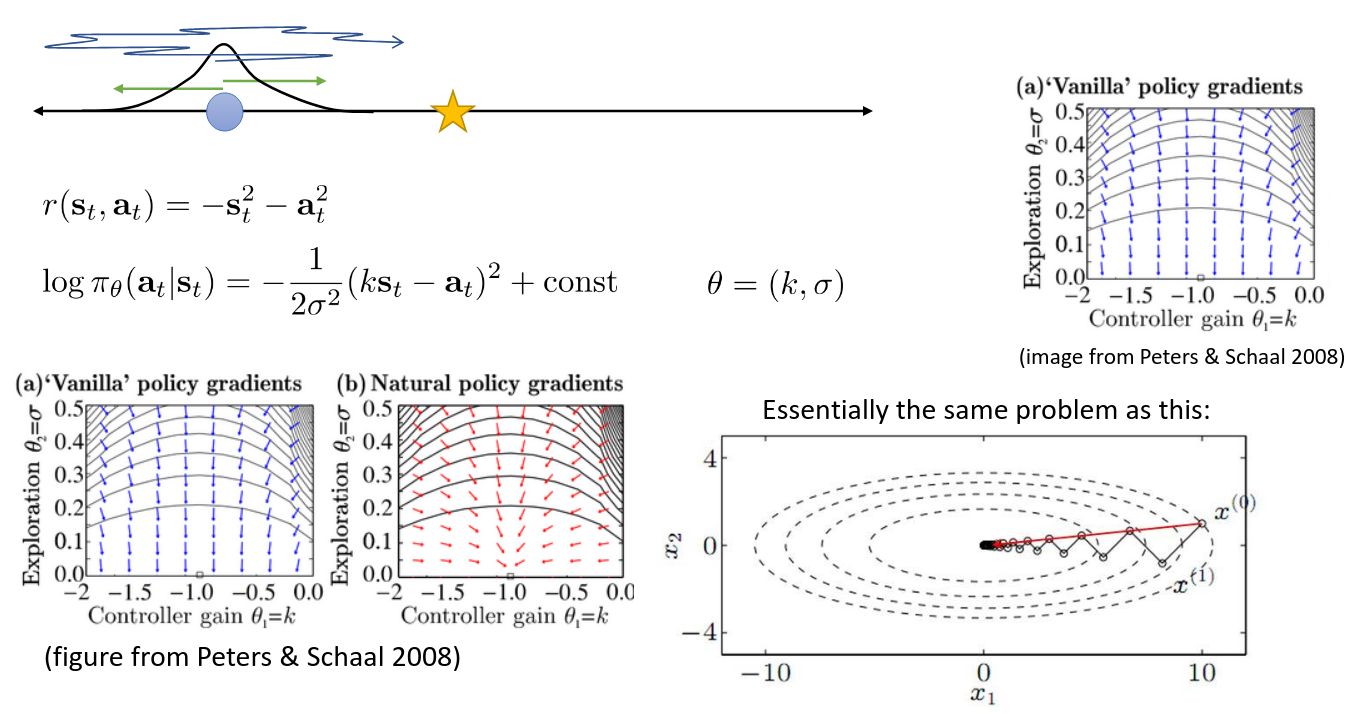
But what's the point of the natural gradient? The idea is that naive gradient ascent experiences problems due to poorly-conditioned functions (see this section from Goodfellow's Deep Learning). See the slide below.

natural-gradient.png

Trust Region Policy Optimization

TRPO is essentially just natural policy gradient.

  1. Sample {τ(i)}\{ \tau^{(i)} \} from πθ(as)\pi_{\theta}(\mathbf{a}\mid \mathbf{s}) (run policy).
  2. Evaluate yt(i)=r(st(i),at(i))+γV^ϕπ(st+1(i))y_{t}^{(i)}=r(\mathbf{s}_{t}^{(i)},\mathbf{a}_t^{(i)})+\gamma \hat{V}_{\phi}^{\pi}(\mathbf{s}_{t+1}^{(i)}).
  3. Refit V^ϕπ\hat{V}_{\phi}^{\pi} to targets {yt(i)}\{ y_{t}^{(i)} \}, minimizing L(ϕ)\mathcal{L}(\phi).
  4. Evaluate A^GAEπ(st(i),at(i))=t=t(γλ)ttδt(i)\hat{A}_{\text{GAE}}^{\pi}(\mathbf{s}_{t}^{(i)},\mathbf{a}_{t}^{(i)})=\sum_{t'=t}^{\infty}(\gamma\lambda)^{t'-t}\delta_{t'}^{(i)}.
  5. θθ+αF1θJ(θ)\theta'\leftarrow\theta+\alpha \mathbf{F}^{-1}\nabla_{\theta}J(\theta).

where F1Ni=1Nt=1Hθlogπθ(at(i)st(i))θπθ(at(i)st(i))\mathbf{F}\approx \frac{1}{N}\sum_{i=1}^{N}\sum_{t=1}^{H}\nabla_{\theta}\log \pi_{\theta}(\mathbf{a}_{t}^{(i)}\mid \mathbf{s}_{t}^{(i)})\nabla_{\theta}\pi_{\theta}(\mathbf{a}_{t}^{(i)}\mid \mathbf{s}_{t}^{(i)})^{\top}.

warning

In practice, building the full matrix F\mathbf{F} and calculating its inverse is far too expensive (quadratic in the number of parameters). Instead, conjugate gradient is typically used. (See here). The TL;DR idea is that you'll only ever use F1\mathbf{F}^{-1} to perform matrix-vector multiplication.

Conclusion

Note that TRPO/natural gradient was the precursor to PPO with KL divergence, i.e. PPO is a refinement that offers lower implementation complexity and lower computational complexity.